Computer Graphics Forum · Pacific Graphics 2026

Blended Chart Surfaces

A Seamless Explicit Representation for Smooth Surface Fitting

  • Romy Williamson
  • Niloy J. Mitra

University College London

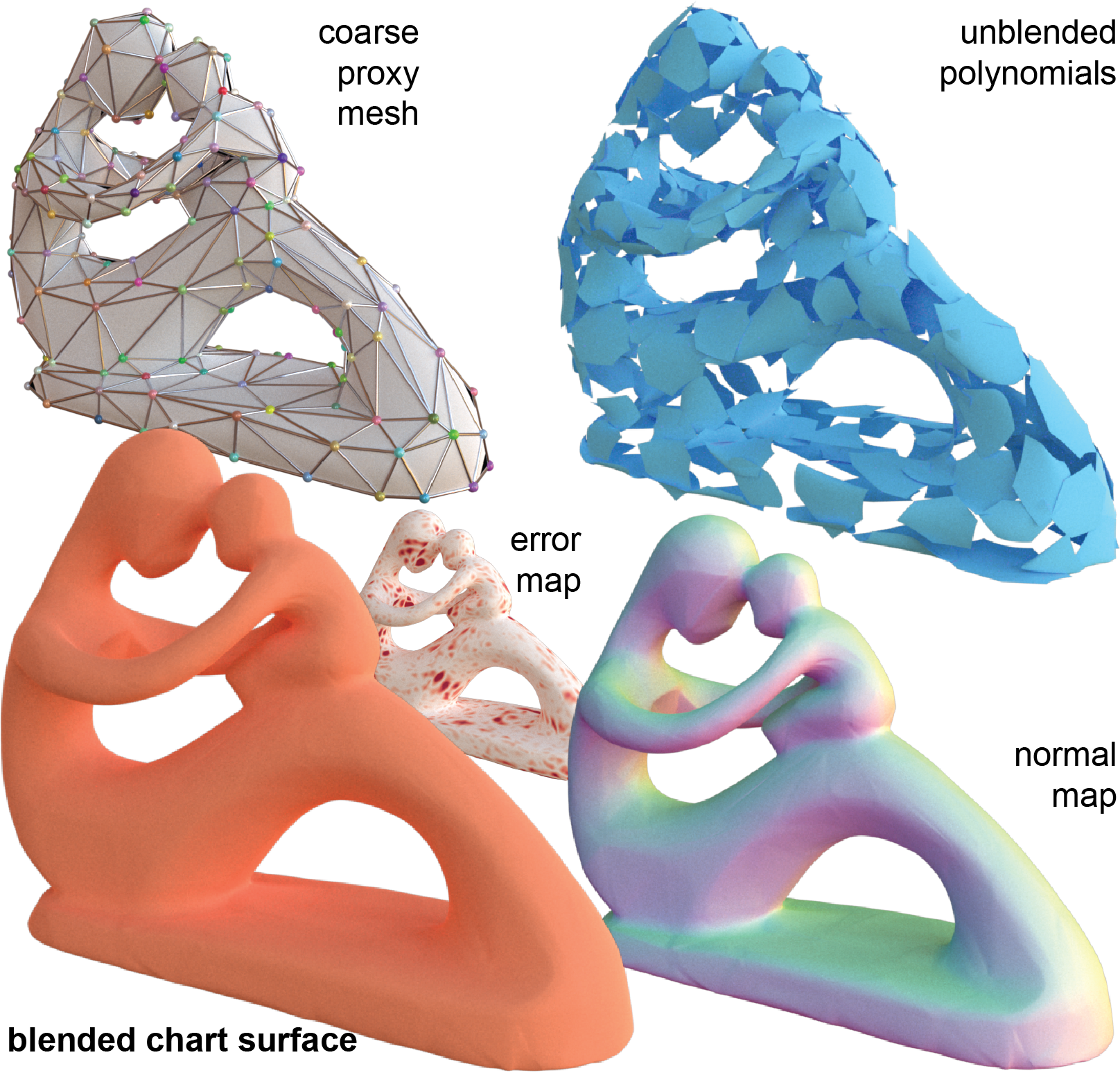
Blended Chart Surface reconstruction of the fertility model, showing coarse proxy mesh, unblended polynomials, blended chart surface, error map, and normal map.

We propose Blended Chart Surfaces, a coarse proxy mesh–guided, network-free, explicit surface representation formed by interpolating between local polynomial maps. The model is compact, faithfully captures surface geometry, and is fully differentiable for optimization in modern learning pipelines.

Abstract

A surface representation suitable for geometry processing should be compact and explicit, provide global smoothness guarantees, support a wide range of surface topologies, and offer reliable access to differential quantities such as normals and surface energies, while remaining compatible with modern differentiable optimization. Yet existing neural representations typically sacrifice one or more of these properties: implicit fields typically require iso-surfacing for downstream use, while explicit neural maps are constrained by canonical-domain parametrizations and/or exhibit seam artifacts between local charts. We introduce Blended Chart Surfaces (BCS), a compact, network-free, explicit representation that is smooth by construction and anchored to user-provided topology. Given a coarse proxy mesh encoding the intended surface topology and approximate geometry, Blended Chart Surfaces jointly optimize for a polynomial map at each proxy vertex using an off-the-shelf optimizer to fit to an implicit target shape, avoiding the need for an input parametrization. Neighboring maps are fused using a smooth ‘one-ring coordinate’ blending scheme, decoupling surface topology and coarse geometry (carried by the proxy) from geometric details (carried by the smooth local patches). The resulting surface is globally smooth, fully differentiable, and enables stable evaluation of positions and derivatives, making differential quantities and surface energies directly accessible. Additionally, our construction is equivariant to rigid motions and scaling of the proxy mesh. We evaluate Blended Chart Surfaces on surfaces spanning varying topology and geometric complexity, and compare against explicit alternatives including interpolating-function baselines and mesh-displacement MLPs. Across these, Blended Chart Surfaces achieves a favorable trade-off among compactness, simplicity, access to differential quantities, and expressivity while remaining smooth across patch boundaries. Code will be released.

Contributions

  1. We introduce a compact, explicit surface representation as a set of overlapping local polynomial patches blended with partition-of-unity weights, yielding global smoothness and enabling end-to-end differentiation and surface fitting.
  2. We encode a target surface on a given coarse mesh by optimizing patch coefficients directly, without expecting any global charting as input, while supporting a broad range of object topologies specified by the proxy — naturally accommodating difficult topologies such as open boundaries and non-orientable surfaces.
  3. We admit progressive levels of detail by increasing polynomial degree (e.g., constant, linear, quadratic, cubic) and/or by refining the proxy, providing a continuum between compactness and faithful reconstructions (i.e., surface fitting).

Method Overview
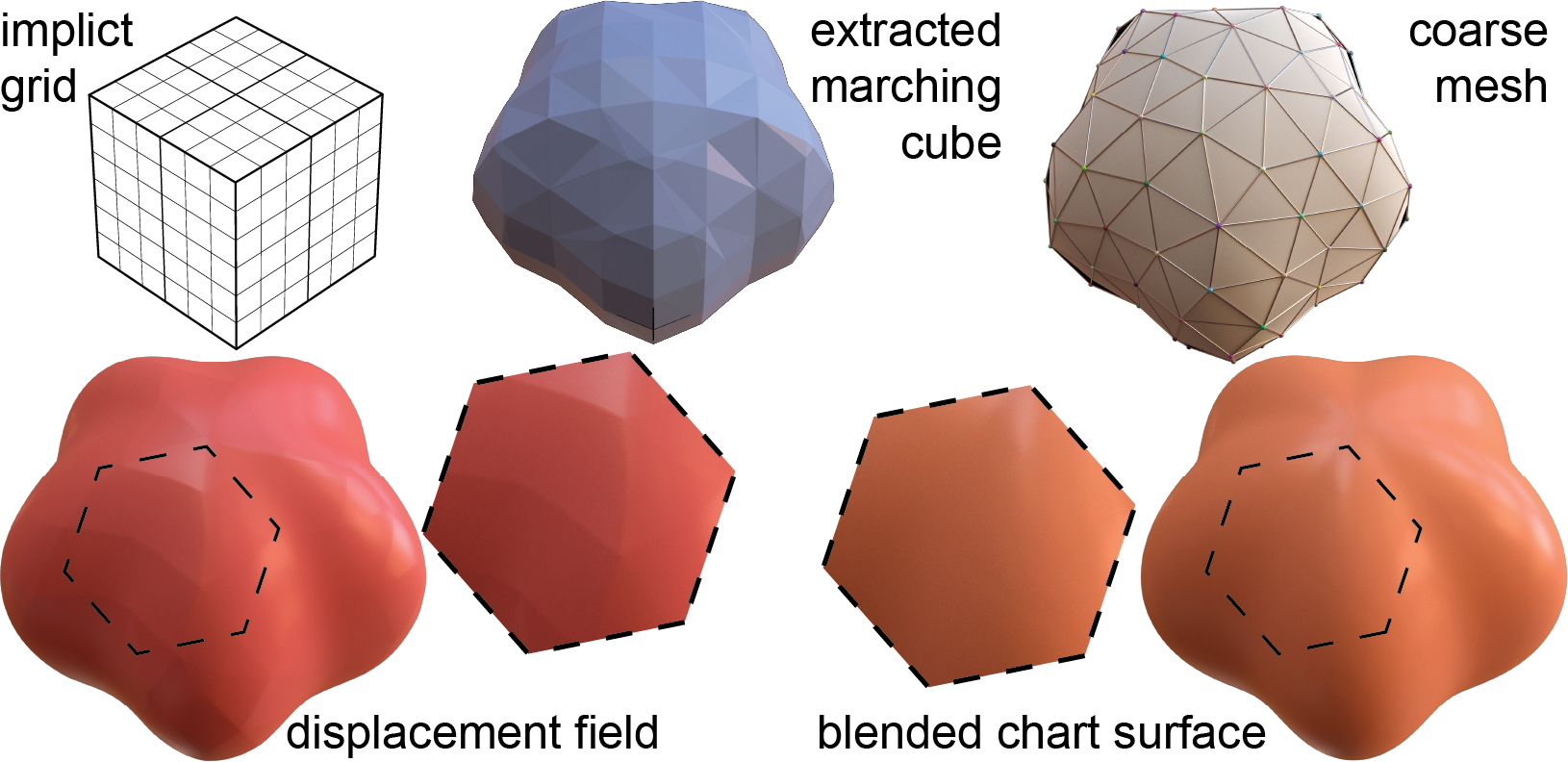
Comparison of implicit grid, extracted marching cube, coarse mesh, displacement field, and blended chart surface.
Motivation. Implicit fields (top-left) require high effective resolution to avoid visible discretization artifacts when extracted with Marching Cubes. Mesh-based displacement fields parametrized by an MLP (bottom-left) require fewer parameters but retain the tangent discontinuities present in the proxy. Our Blended Chart Surface (right) learns on a coarse proxy mesh yet yields an explicit surface that is, by construction, C smooth across patch boundaries.
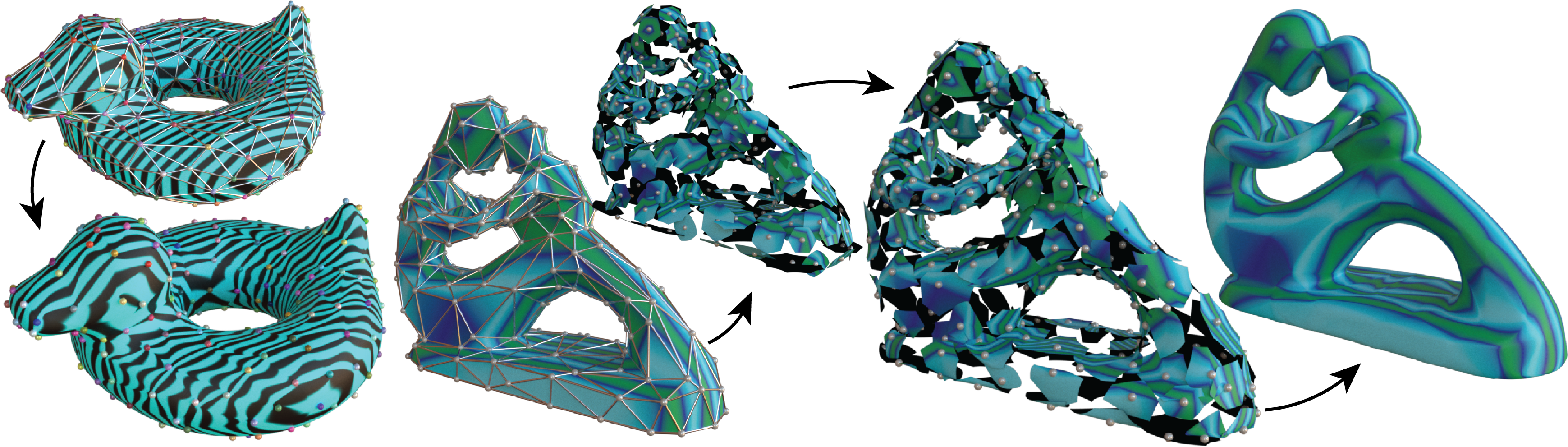
Blended Chart Surfaces inducing a seamless correspondence between proxy and fitted surface via one-ring coordinates.
Discovering a surface parametrization. Blended Chart Surfaces implicitly induce a seamless correspondence between the proxy and the fitted surface via the one-ring coordinates and blended local maps. A color field defined on the coarse proxy is pushed through the optimized patches and transferred to the final Blended Chart Surface.

2D Results — Blended Chart Curves

The construction first specializes to the 1D/2D curve case: a vertex function is assigned to each vertex of a coarse proxy polygon, and neighboring functions are fused with a smooth blending scheme to produce a curve that is C by construction and equivariant to rigid motions and scaling of the proxy.

Blended chart curve fitting pipeline reconstructing a shark outline from a target signed distance field and a coarse proxy polygon.
Blended chart curve fitting. (Left to right) We start from the target implicit field (a closed-curve SDF) and a coarse proxy polygon (V, E). At each vertex we optimize a local map parametrized by degree-5 polynomials together with its associated local frame (rotation, translation, scale). These optimized curvelets are repositioned to form the vertex functions, which are combined via the blending functions to produce the blended chart curve defined over the coarse proxy. The result is smooth by construction and equivariant to rigid motions and scaling of the coarse proxy.

3D Results — Blended Chart Surfaces

In 3D, a C-continuous local map is associated with each vertex of a coarse triangle mesh using one-ring coordinates, and neighboring maps are fused with a partition-of-unity blending function. Fitting optimizes the per-vertex polynomial coefficients directly against an implicit target, with no global parametrization required.
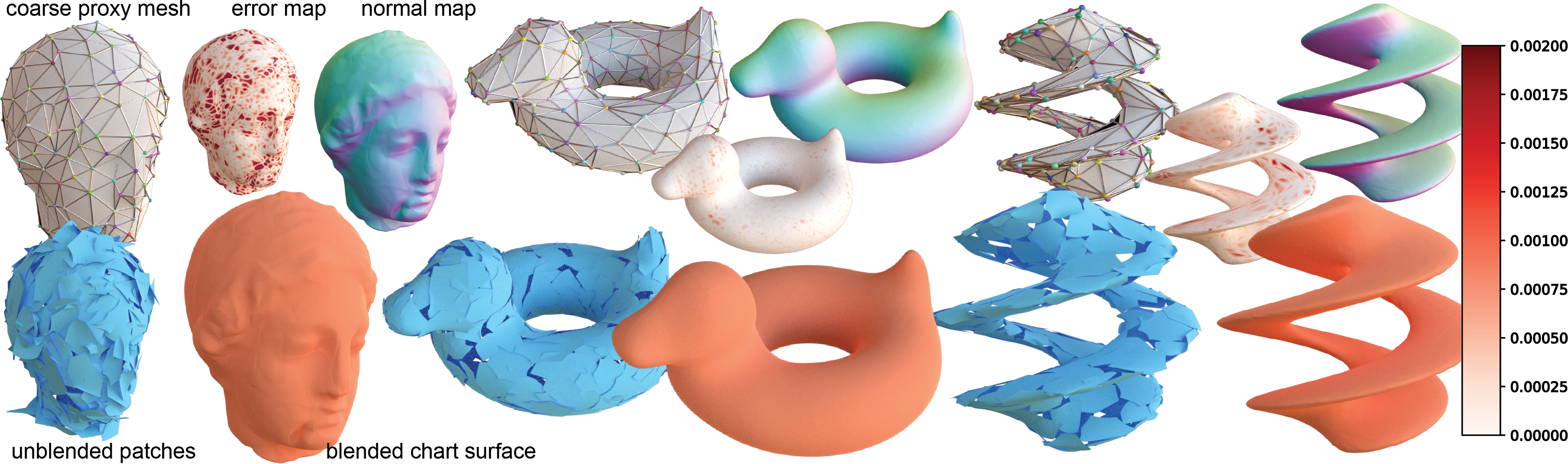
Result gallery: Igea head, twisted torus, and Bob duck showing coarse proxy mesh, unblended patches, blended chart surface, error map, and normal map.
Result gallery. BCS on different targets (Igea, Bob, and a twisted torus). For each model we show the coarse proxy mesh, the optimized but unblended local polynomial patches, the resulting Blended Chart Surface, and the corresponding error map (color bar at right; models normalized to a unit-width bounding box). We also visualize the normal map to highlight stable, smoothly varying normals. All results use quadratic patches (18 scalar coefficients per vertex); proxy meshes have 252, 250, and 200 vertices, respectively.
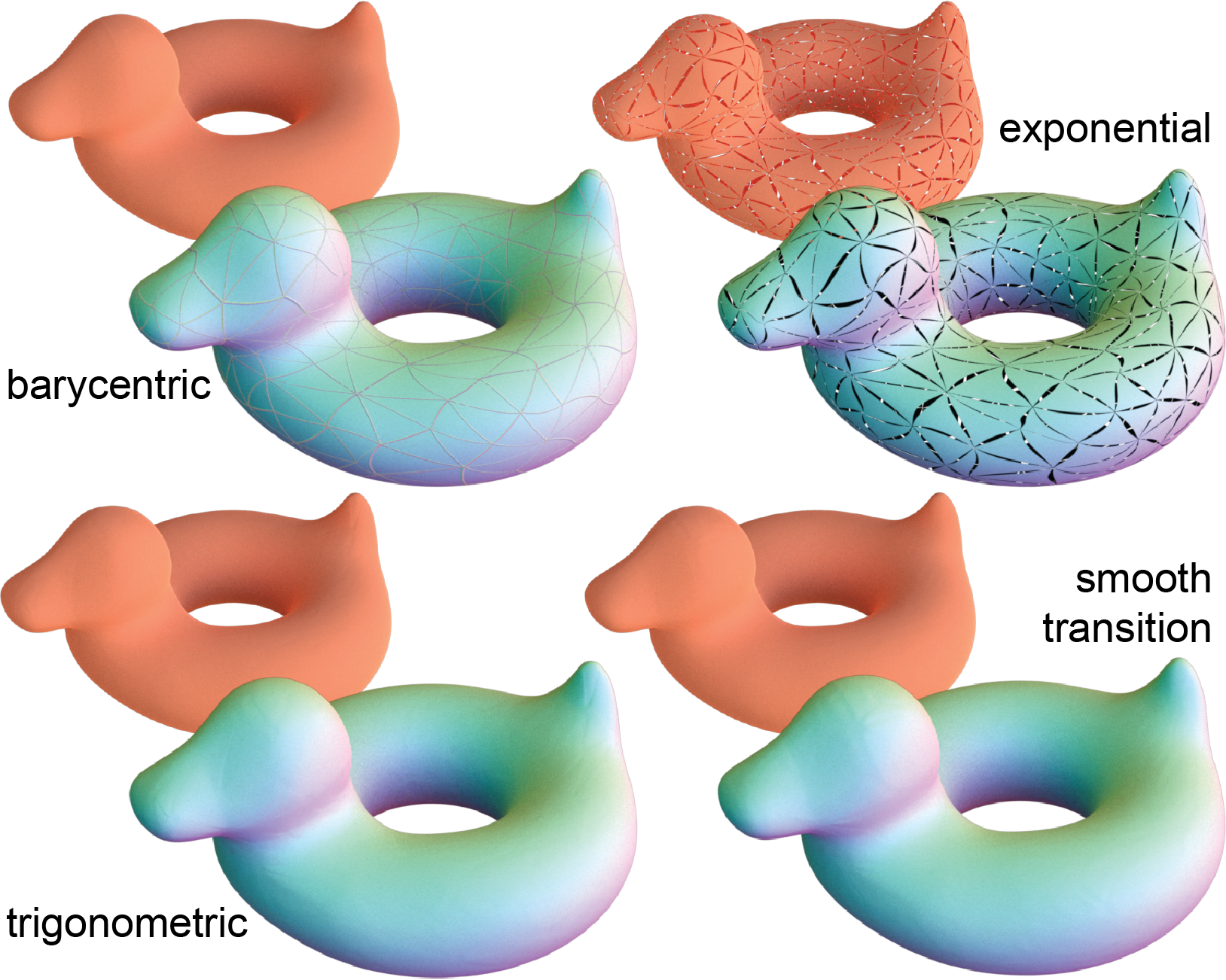
Effect of blending function: barycentric, exponential, trigonometric, and smooth-transition blending on a torus.
Effect of the blending function. Barycentric blending yields only C0 continuity, with normals ill-defined along coarse mesh edges. Direct exponential weighting fails to preserve even C0 continuity at edges, producing visible holes. Trigonometric blending achieves C1 continuity and looks smooth; our smooth-transition blending is C and globally smooth.
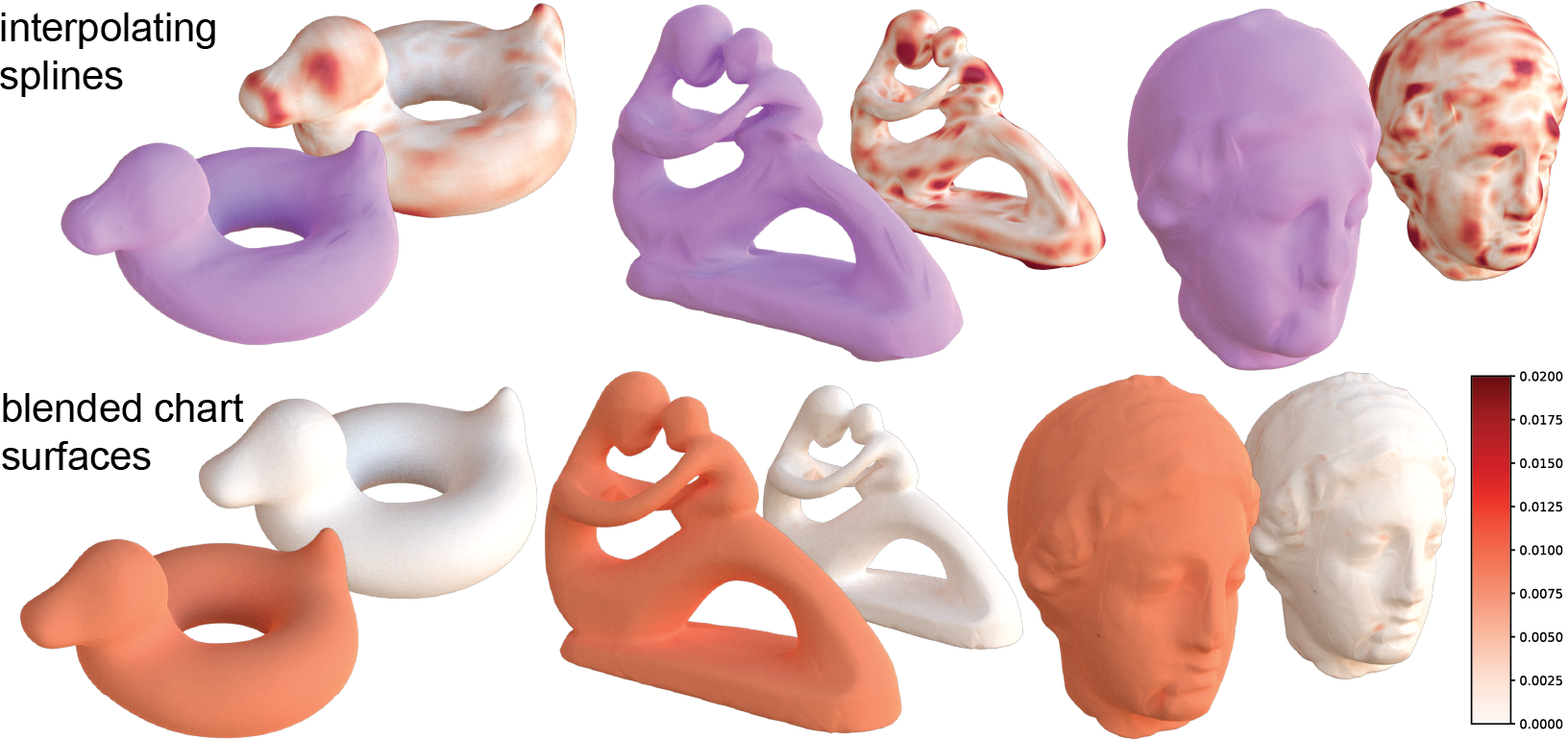
Comparison of interpolating splines and blended chart surfaces on Bob, Fertility, and Igea, with error maps.
Comparison with Djuren et al. [DFK*25]. Both methods use the same proxy meshes and quadratic vertex polynomials. Vertex-Centric Interpolating Splines use individually optimal vertex functions to interpolate the coarse vertices, whereas we jointly optimize coupled local maps guided by the target implicit. Error maps (UDF) show our reconstruction is more faithful on the same coarse mesh.
Effect of coarse proxy resolution on fitting a rippled torus target for 100, 150, and 250 vertices.
Effect of the coarse proxy mesh on fitting quality. We fit Blended Chart Surfaces to a ‘rippled’ target with strongly varying curvature using proxy meshes of increasing resolution (|V| = 100, 150, 250). Results are largely robust to proxy connectivity; at very low resolution the local optimization can stall, leading to underfit regions in high-curvature areas (see zoomed insets). Increasing proxy resolution improves fidelity. Front row shows the surfaces; back row shows zooms and normal maps.
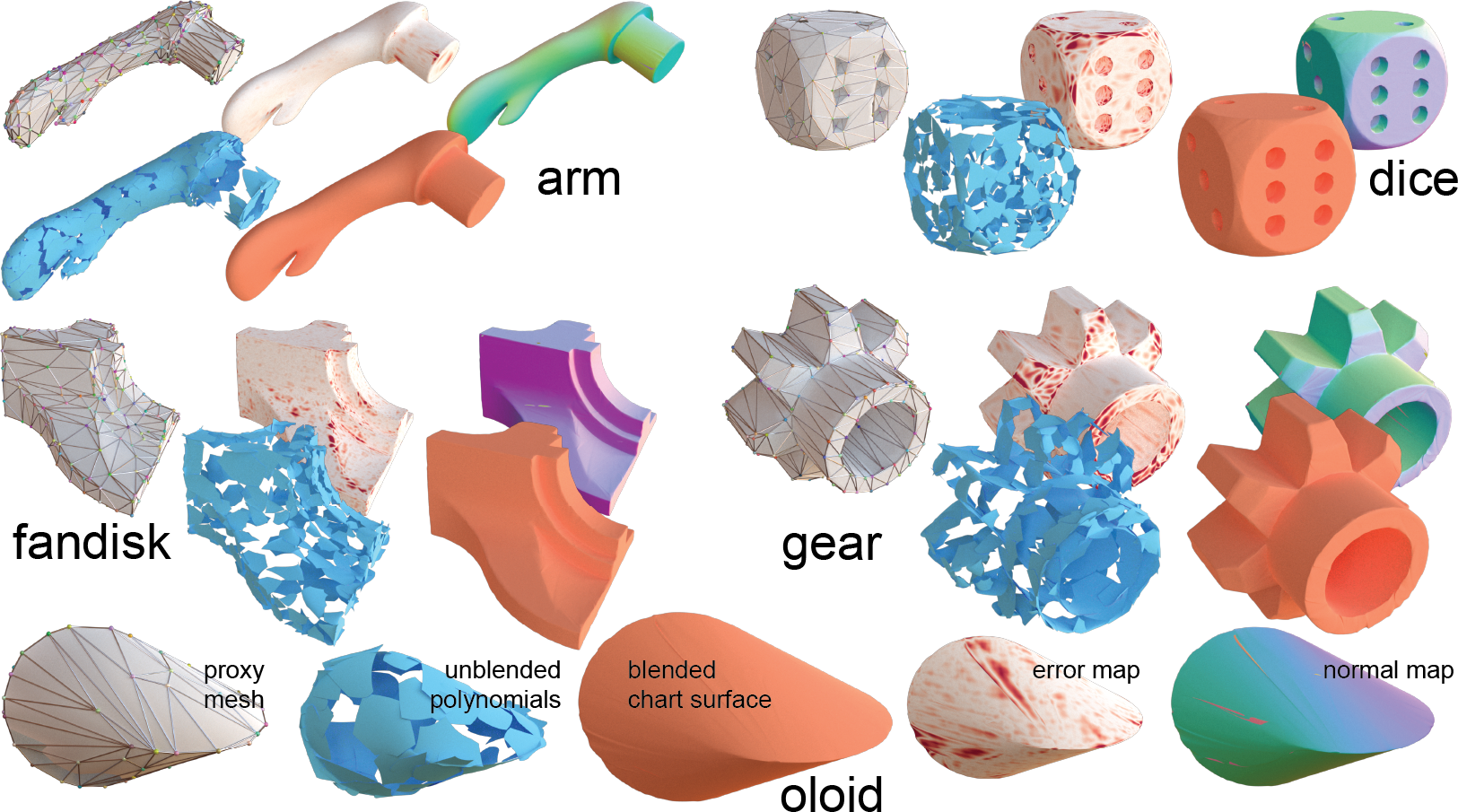
Limitations: BCS reconstructions of arm, dice, fandisk, gear, and oloid, which contain sharp edges.
Limitations. BCS on five surfaces that contain sharp edges (Arm, Dice, Fandisk, Gear, Oloid). The reconstructions are slightly over-smoothed and the highest errors generally appear along the intended sharp edge. This is expected, since the BCS parametrization is mathematically smooth by construction.

Quantitative Evaluation

We quantify one aspect of surface quality by measuring the extent of the BCS surface area that is flipped in orientation with respect to the ground-truth surface.
Model% Flipped Area
Neural SDFs
Igea (500 faces), Degree 30.10
Igea (500 faces), Degree 2 (truncated)0.07
Igea (500 faces), Degree 1 (truncated)0.01
Igea (500 faces), Degree 20.15
Bob (500 faces), Degree 20.01
Fertility (500 faces), Degree 20.02
Analytic Implicits
Wobbly Torus (500 faces), Degree 20.00
Wobbly Torus (300 faces), Degree 20.00
Wobbly Torus (200 faces), Degree 20.09
Twisted Torus (500 faces), Degree 20.01
Urchin (210 faces), Degree 20.00

Acknowledgements

The authors thank Navami Kairanda for valuable discussions on an earlier version of this work, Mariusz Tang for proofreading, and Yilin Liu for his patient technical help with the neural SDFs. RW was supported by the Engineering and Physical Sciences Research Council (grant number EP/S021566/1).

BibTeX

@article{williamson2026blended,
  title   = {Blended Chart Surfaces: A Seamless Explicit
             Representation for Smooth Surface Fitting},
  author  = {Williamson, Romy and Mitra, Niloy J.},
  journal = {Computer Graphics Forum},
  year    = {2026},
  note    = {Proceedings of Pacific Graphics 2026},
}